Key Changes and Improvements
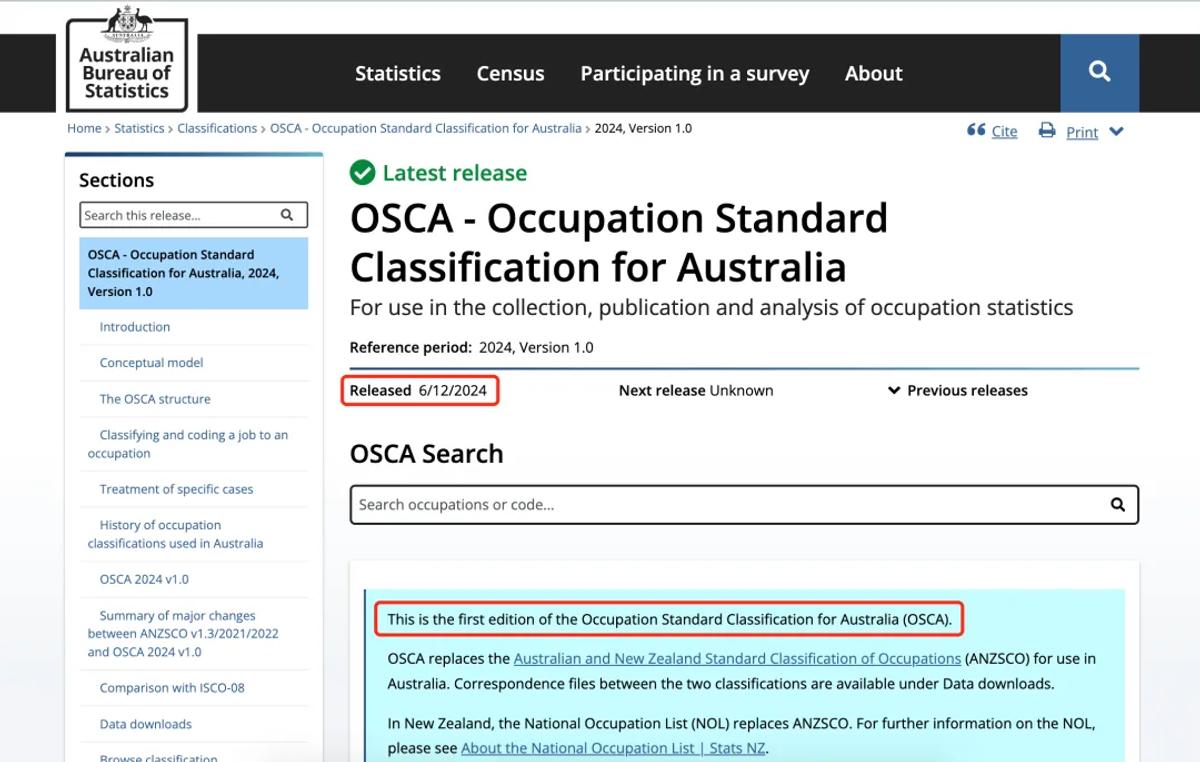
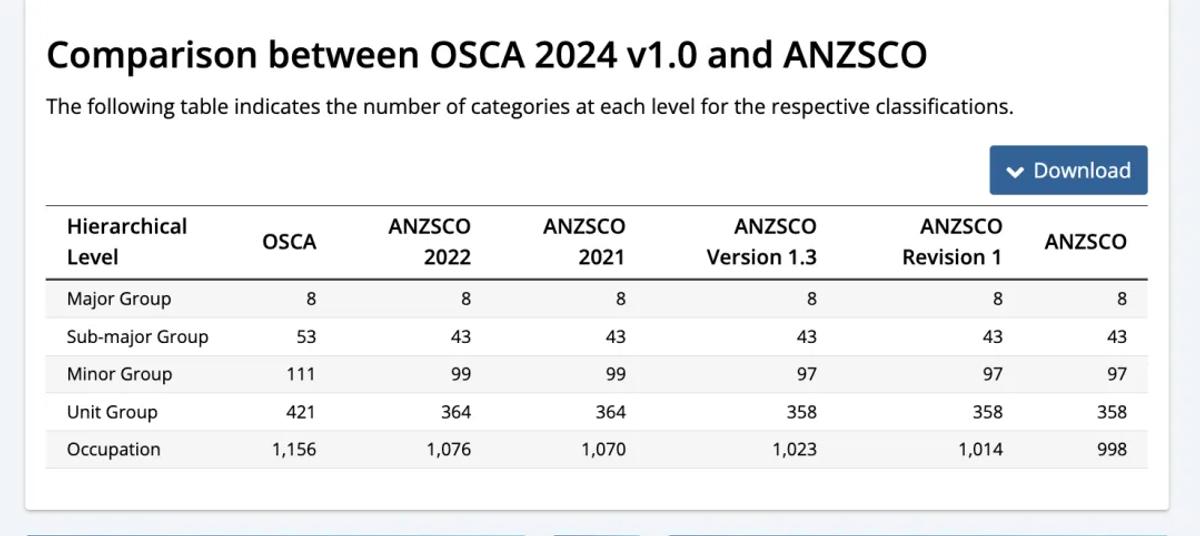
The Australian Bureau of Statistics (ABS) released the latest version of the Occupation Standard Classification for Australia (OSCA) in 2024, known as OSCA 2024 v1.0. This new version replaces the previous Australian and New Zealand Standard Classification of Occupations (ANZSCO), aiming to more accurately reflect the current state of Australia's labor market and improve the balance and granularity of statistical data.
1. Reclassification of Management Positions
Specialist Managers: In ANZSCO, Sub-major Group 13 Specialist Managers has been subdivided into three sub-major groups:
Business Administration and Promotion, and ICT Managers
Construction, Production and Distribution Managers
Education, Health, Welfare and Other Specialist Managers
Hospitality, Retail and Service Managers: ANZSCO's Sub-major Group 14 has been split into two sub-major groups:
Hospitality and Retail Managers
Office Administration and Service Managers
2. Clarification of Professionals Classification
Major Group 2 (Professionals): OSCA 2024 limits Major Group 2 to Skill Level 1 occupations only. Professionals not at Skill Level 1 in ANZSCO have been redistributed to other major groups. Skill Level 1 non-managerial occupations from other major groups (except Major Group 1) have been incorporated into OSCA's Major Group 2.
Arts, Media, and Legal Professionals: ANZSCO's Sub-major Groups 21 and 27 have been reorganized into:
Cultural and Social Professionals
Legal Professionals
3. Split of Business, Finance, and Marketing Professionals
ANZSCO's Sub-major Group 22 has been split into:
Accounting and Finance Professionals
Business Professionals
4. Changes to Technicians and Trades Workers
Automotive and Engineering Trades Workers: ANZSCO's Sub-major Group 32 has been split into:
Engineering Trades Workers
Automotive Technicians and Trades Workers
Construction Trades Workers: ANZSCO's Sub-major Group 33 has been split into:
Building Completion and Related Trades Workers
Building Structural Trades Workers
5. Improved Classification of Community and Personal Service Workers
Health and welfare support workers and carers have been reorganized from two sub-major groups into four, better reflecting work in community welfare, aged care, early childhood education, and health support.
6. Improved Classification of Clerical and Administrative Workers
Numerical clerks and other clerical workers have been reorganized from two sub-major groups into four, better reflecting the diversity of financial, accounting, supply chain support, and other clerical work.
Objectives and Significance
These changes not only improve the statistical balance of occupation classification and increase the granularity of published occupation data, but also better reflect the actual situation of Australia's labor market. OSCA 2024 v1.0 particularly enhances the identification of Aboriginal and Torres Strait Islander occupations and female-dominated occupations, ensuring the inclusiveness and representativeness of the classification system.
Conclusion
The release of OSCA 2024 v1.0 marks a significant upgrade to Australia's occupation classification system, providing a more precise data foundation for policymakers, researchers, and businesses, as well as a clearer occupation classification guide for job seekers and employers.