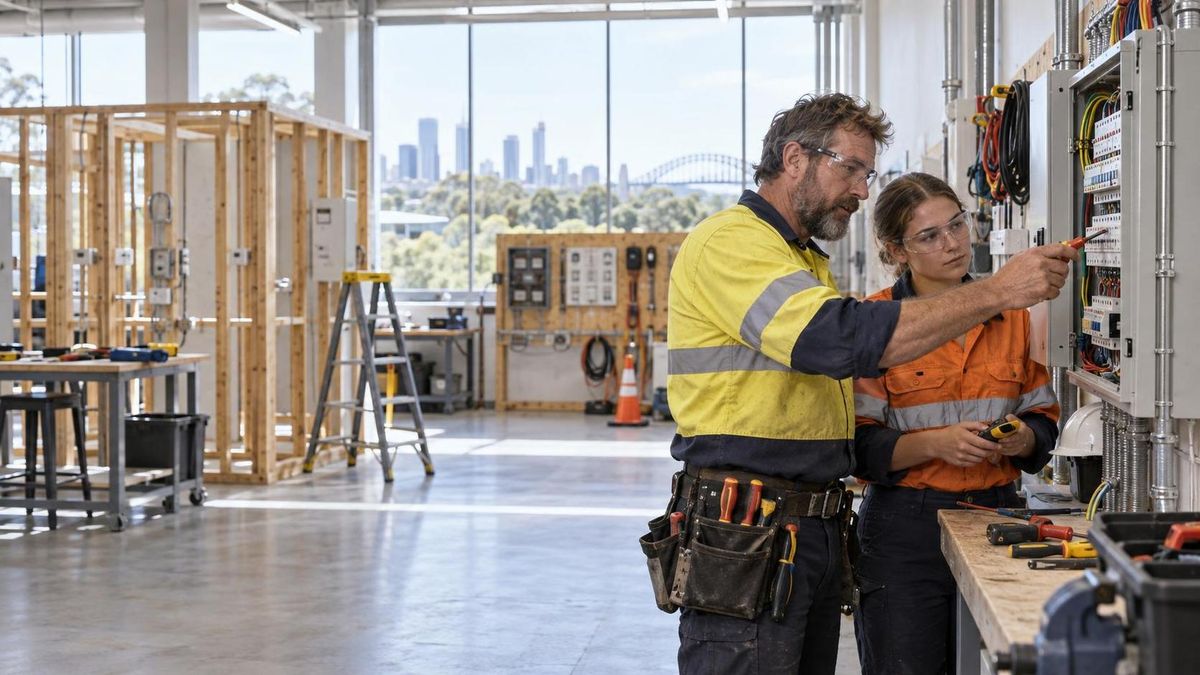
Why is Australia investing A$5 million to help tradies train tradies?
On 9 October 2026, Australia’s Minister for Skills and Training, Andrew Giles, announced A$5 million in pilot funding to help experienced construction and electrical tradespeople enter the vocational education and training (VET) workforce as teachers, trainers and assessors.
Participants will be able to complete a Certificate IV in Training and Assessment at no cost, with mentoring, induction support and practical experience through participating TAFEs and registered training organisations (RTOs). BuildSkills Australia and Powering Skills Organisation will work with RTOs and industry partners to attract and support eligible tradespeople.
The announcement is formally about VET teachers. The wider signal is more important: Australia does not only need more skilled workers; it also needs enough people with current industry experience to train the next generation.
This is more than a general training-sector recruitment program
Construction, electrical work, housing, energy transition and major infrastructure projects all depend on a steady flow of new workers. Increasing course numbers is not enough if the training does not reflect current sites, equipment and safety requirements.
The announcement focuses on two linked objectives:
- making it easier for experienced tradespeople to enter the VET workforce; and
- preserving practical industry knowledge while those tradespeople build teaching and assessment capability.
That is why the pilot combines a free Certificate IV in Training and Assessment with mentoring, induction and practical experience. The goal is not only to create more certificates, but to build a stronger training workforce.
What could this mean for construction and electrical tradespeople?
A career direction that grows from field experience
For experienced carpenters, electricians, building installers and other technical workers, career development does not have to mean staying in exactly the same site role forever. Some continue in the field; others move into supervision, project coordination, technical support, training or assessment.
This pilot creates a clearer route into one of those adjacent directions: using industry experience to build the capability to train apprentices and new workers through a TAFE or RTO.
The scope still needs to be kept accurate. The announcement confirms the funding and pilot design, but participation criteria, locations, places and application arrangements will depend on the participating organisations. It should not be read as an automatic program for every offshore tradesperson or as a new visa pathway.
Experience still needs to be translated into a recognised capability
The program also shows that practical experience is valuable but does not automatically equal a training qualification. Participants still need to complete the Certificate IV in Training and Assessment and meet the requirements of the relevant training arrangement.
For people with mixed backgrounds, that creates a useful form of flexibility: previous site experience is not discarded, but becomes the foundation for a new stage of learning and work. Whether someone can move into a specific role will still depend on qualifications, industry experience, communication, teaching capability and the requirements of the provider.
Skills policy is becoming more specific
Australia’s skills conversation is increasingly about more than the number of workers needed. It is also about:
- who can train those workers;
- whether training keeps up with equipment, energy and construction changes;
- how experienced tradespeople can remain active in the industry; and
- how skills, qualifications and work experience can connect more effectively.
The A$5 million pilot is therefore not a large migration measure. It is an investment in the training infrastructure behind construction, electrical, housing, energy and infrastructure work. It will not immediately create a new pool of overseas jobs, but it may influence the future supply of workers and trainers.
What should offshore applicants and multi-skilled workers take from it?
For anyone considering construction, electrical, equipment maintenance or engineering work in Australia, the announcement offers several practical observations.
First, Australia needs people who can apply skills in real roles and projects, not only people who hold a certificate. Skills assessment, employer recruitment and any later pathway still come back to the occupation code, duties, qualifications and evidence.
Second, career planning can retain some flexibility. Site work, technical management and training are not necessarily mutually exclusive, but each direction has different qualification and employer requirements. Years of experience do not automatically remove the need for assessment.
Third, long-term demand in construction and electrical work may also appear in training, technical support, compliance and project management roles. For people with mixed experience, understanding these adjacent directions can help them decide whether to remain in a hands-on role or gradually add training and technical management capability.
When Noice International assesses an applicant’s occupation and pathway, the aim is to look at work history, qualifications, duties and future direction together. Where relevant, the occupation, employer, location and evidence can then be considered against possible 482/SID, 494, DAMA or 186 pathways.
This A$5 million pilot is not a visa program and does not make a direct promise to offshore applicants. Its industry signal is nevertheless clear: Australia is strengthening both the frontline trades workforce and the system that trains it. For people with substantial experience, qualifications or an interest in moving toward training and technical management, it is a trend worth watching.
Sources and scope
- Australian Government Ministers’ Media Centre: $5 million for more tradies to train tradies of the future
- BuildSkills Australia: Your Next Big Project
- Powering Skills Organisation
- This article is general information, not migration, skills-assessment or employment advice. Participation criteria and future arrangements should be confirmed with the official program and participating training providers.